Communities and Reparation Efforts
Communities are at the center of reparation efforts. While colleges and universities have a role to play in addressing and supporting reparations, the communities that the campus is a part of is where the work of naming the harms done, crafting solutions, and embedding the repair happens. The mantra of reparations work is “nothing about us without us” – a principle used to communicate the idea that no policy should be decided by any entity without the full and direct participation of members of the group(s) affected by that policy. The work of HERE has been influenced and guided by community partners.

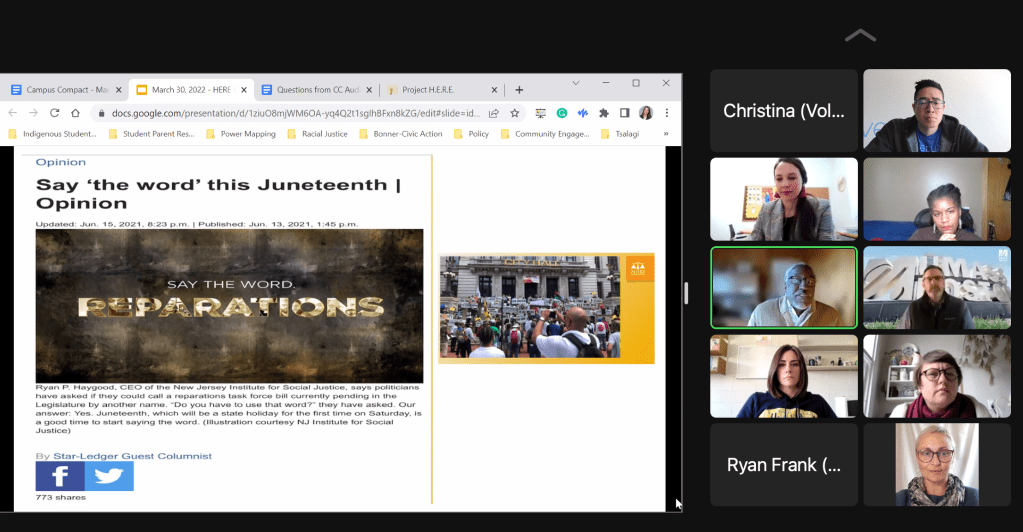
Communities Doing the Work
Embrace Boston – embraceboston.org
In the wake of 2020’s summer uprisings for racial justice, Embrace Boston sought pathways to healing and joined with other Black leaders from across Massachusetts to form the Black Mass Coalition to guide individuals and organizations in the private sector, the nonprofit and philanthropy worlds, and the halls of government attempting to determine how they should respond to the constant rage of an oppressed people. The group created the Blueprint for a New World for Massachusetts to strive to heed and follow. On the heels of this Blueprint, which also calls for the creation of a $1 billion Reconstruction and Rehabilitation Fund to support BIPOC institutions, Black and Indigenous-led nonprofits and businesses, and other reparative efforts, King Boston put a stake in the ground around coordinating local reparations efforts in Boston in partnership with faculty at University of Massachusetts Boston.
Guided by an intention to build from other local reparations efforts, King Boston developed a partnership with the National Coalition of Blacks in America (N’COBRA) who conducted a teach-in for HERE on the framework they have developed to guide local reparations efforts, demonstrated most notably in Evanston, IL where a reparations program grounded in housing was launched in 2021. The partnership with National N’COBRA soon led to a partnership with the New England co-chair of N’COBRA and a discovery of multiple reparations-focused efforts underway across the Commonwealth of Massachusetts. Thereafter, King Boston and N’COBRA New England, organized a statewide conversation to share about local reparations efforts and to begin imagining what a statewide advocacy agenda around reparations could look like; that initial meeting was attended by over 80 individuals and representatives from social justice organizations and included at least one elected official. The group is interested in advocating for legislation to support the creation of a Truth and Justice Commission, similar to what is proposed in federal HR40; such legislation was introduced in the 2019-20 legislative session but the co-sponsors (Rep. Liz Miranda and Sen. Nick Collins) have declined to re-introduce the bill. Conversations, however, with Rep. Liz Miranda led to an invitation for King Boston to testify before a new Joint Committee on Racial Equity, Civil Rights and Inclusion to advocate that the Committee focus on the issue of reparations (see testimony). In parallel efforts, the NAACP Boston branch worked with Boston City Councilor Julia Mejia to introduce an order for a hearing on reparations during a June 2021 city council meeting.
King Boston recognizes that the case for local reparations is just one part of a broader reconciliation needed in the United States and that federal reparations are ultimately required. However, as we have learned from our partners at N’COBRA, local reparations efforts begin to prepare the infrastructure needed to implement a federal program and also helps to create and maintain a political landscape favorable to reparations.
Brown Hope Project – brownhope.org
Brown Hope, located in Portland, Oregon, is a community solution for racial justice, creating connection with Black, Brown, and Indigenous leaders through the heart, mind, and voice to inspire our collective healing. envision a future where the truth about this nation’s long history of injustice is self-evident. Brown Hope envisions the survivors of this injustice taking the lead on change. We envision love as a lived, and collective, experience. Learn more.
MORE: Mayors Organized for Reparations and Equity – moremayors.org
The idea of reparations for Black Americans has been locked in a conversation that has hardly moved beyond theory since the end of the Civil War. The members of Mayors Organized for Reparations & Equity (MORE) are committed to moving that needle with action and advocacy that points toward justice and healing the wounds of history. Our coalition stands on the belief that cities can — and should — act as laboratories for bold ideas that can be transformative for racial and economic justice on a larger scale, and demonstrate for the country how to pursue and improve initiatives that take a reparatory approach to confronting and dismantling structural and institutional racism.
Cities:
- Los Angeles, CA
- Stockton, CA
- Sacramento, CA
- Denver, CO
- St. Paul, MN
- Kansas City, MO
- St. Louis, MO
- Ashville, NC
- Carrboro, NC
- Tullahassee, OK
- Providence, RI
- Austin, TX
New Jersey Reparations Council
Relying on comprehensive research, writing and community input, the New Jersey Reparations Council will be the first comprehensive step on a statewide level to acknowledge and repair New Jersey’s deep history of slavery and its enduring harm to Black people in the state.
The Council will shine a light on structural racism in New Jersey from slavery to today, and propose bold, transformative policy recommendations for repair.
Through its recommendations, the Council will seek not only to end the harm to Black people from slavery and what followed, but also to answer the affirmative question: What kinds of reparative systems does New Jersey need to build and invest in for Black people to thrive?
NJISJ (New Jersey Institute for Social Justice)
The Institute’s cutting-edge racial and social justice advocacy seeks to empower people of color by building reparative systems that create wealth, transform justice and harness democratic power—from the ground up—in New Jersey.
Known for our dynamic and independent advocacy aimed at toppling load-bearing walls of structural inequality to create just, vibrant and healthy communities, we are committed to exposing and repairing the cracks of structural racism in our foundation that erupt into earthquakes in communities of color.
The Institute advocates for systemic reform that is at once transformative, achievable in the state and replicable in communities across the nation.

 Project H.E.R.E. (Higher Education Reparations Engagement)